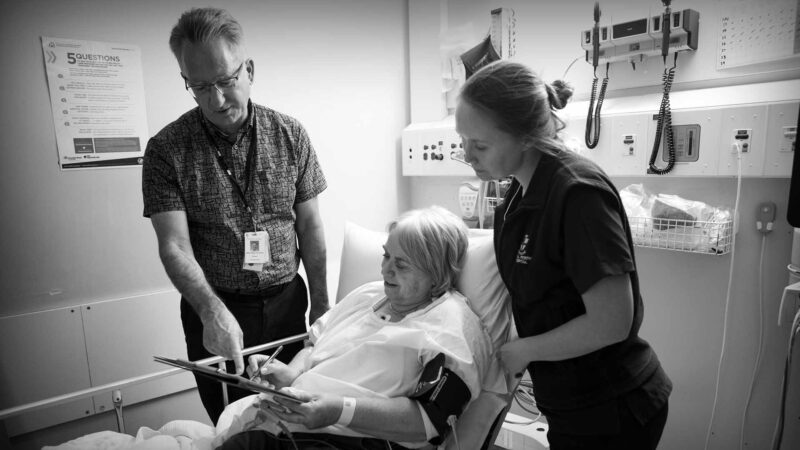
INDIGENOUS AUSTRALIAN HEALTH AND EAR DISEASE
Professor Kelvin Kong AM,
Royal Australasian College of Surgeons Fellow Otolaryngology, Head and Neck Surgeon Worimi Nation, Australia &
School of Medicine and Public Health, University of Newcastle, Australia &
Honorary Professor, Macquarie University &
Adjunct Professor, University of NSW, Australia
RESEARCHER PROFILE
Filmed in Newcastle, NSW, Australia | October 2025
Professor Kelvin Kong feels incredibly fortunate to lead a fulfilling life surrounded by his loved ones. With a demonstrated history of service in the health industry, he brings a wealth of expertise across various sectors including clinical research, medical education, surgery, paediatrics, health policy, and Indigenous education. Kelvin started his university, residing at New College in 1992, which brings him fond memories. Graduating from medicine from the University of NSW, Kelvin continued his studies and became a fellow of the Royal Australasian College of Surgeons (RACS) and Australian Society of Otolaryngology, head & neck Society (ASOHNS).
Based in Newcastle on Awabakal and Worimi Country, Kelvin specialises in Paediatric & Adult Otolaryngology, Head & Neck Surgery. His practice encompasses a diverse range of adult and paediatric patients, with a particular interest in Paediatric Airway and Cochlear Implantation.
Beyond his clinical work, Kelvin is deeply committed to community service. His dedication to improving health outcomes extends to his role as a Professor at the University of Newcastle’s School of Medicine and Public Health, as well as his Honorary Professorships at Macquarie University and Associate Professorships UNSW. He established the Muku (Ear) Indigenous Ear Research program and strongly involved in many facets of research, particularly in relation to engaging community in research and creating career pathways. He is the senior examiner of the ORL Mini-court for RACS and member of the National Ear and Hearing Health Partnership Committee to highlight a few.
Hailing from the Worimi people of Port Stephens, NSW, Kelvin’s heritage informs his passion for health and education improvement initiatives. He remains grounded by the support of his family, who continue to inspire him in his efforts to give back to the community. Through his advocacy, research, and clinical practice, Kelvin strives to make a positive impact on the lives of others, guided by his commitment to equity and the well-being of all.
Source: Supplied
https://orcid.org/0000-0002-8384-0149
You Might also like
-
Genetic disease research imitating function and architecture of organs
Professor Wolvetang was among the first to bring the first human embryonic stem cells to Queensland, with his Wolvetang Group at the AIBN now renowned for its work with organoids: growing them, studying them, and using them to try and understand diseases and human development.
Using cutting edge technology, Professor Wolvetang designs and grows organoids both for their own work and for labs across the country, coaxing pluripotent stem cells or tissue samples into 3D structures that mimic the function and architecture of real brains, livers, kidneys, spinal cords, and intestines.
-
Antimicrobial technologies & drug delivery platforms
Dr Aaron Elbourne is an ARC DECRA Fellow, Jack Brockhoff ECR Fellow, and Associate Professor within the School of Science at STEM Hub. A leader in nanomaterials, soft matter science, and interface research, Aaron’s work addresses critical challenges in health and the environment.
With a strong focus on translational research, Aaron’s work bridges the gap between fundamental science and practical applications. His leadership in creating innovative technologies, fostering academic-industry partnerships, and empowering future researchers underscores his commitment to advancing science and creating a meaningful impact.
-
Relationship between language-literacy skills and mental health
In an innovative move towards enhancing mental health services, Associate Professor Amanda Neil and team, supported by the RHH Research Foundation, are undertaking a crucial study on language-literacy skills of patients within mental health care settings. This year-long project, which commenced in April 2024, seeks to unravel to what extent, where and for whom language-literacy skills are being considered in Tasmanian mental health service provision.